Research Interests
My doctoral and postdoctoral research centered on refining molecular portraits of cancer in the light of their evolutionary and ecological features, with the goal of advancing genomic diagnostics. In research faculty and industry leadership roles, my interest has broadened to developing digital biomarkers that identify high-risk patients who are currently overlooked, improving algorithm performance in diverse clinical settings, and exploring the underlying pathophysiological mechanisms.
Refining Genomic Biomarker Design in Light of Cancer Evolution
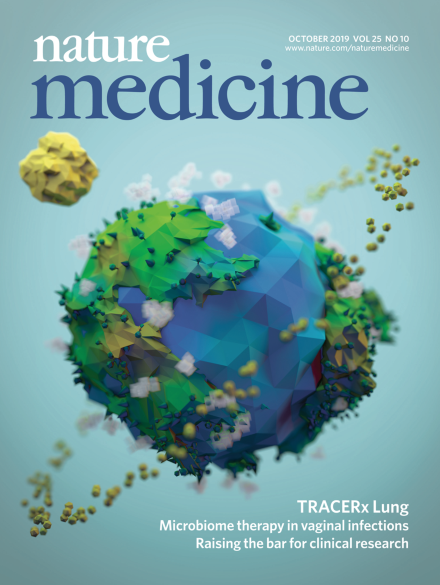
Lung cancer remains the leading cause of cancer mortality worldwide. A major contributor is undertreatment of early-stage disease, driven by the difficulty of identifying patients whose tumors are biologically aggressive and who may benefit from intensified therapy. ORACLE was developed to address this gap: a genomic biomarker that applies principles from cancer evolution to quantify tumor aggressiveness and improve risk stratification.
ORACLE was built using multi-regional tumor datasets and an integrated analytical pipeline spanning genomics, machine learning, and clinical survival modelling, linking clonal expression patterns to patient outcomes. In the initial study, ORACLE provided prognostic information beyond standard clinicopathologic variables (Biswas et al. Nature Medicine 2019). The biomarker was subsequently prospectively validated in an independent, multi-centre cohort, supporting robustness across settings (Biswas et al. Nature Cancer 2025). Patent protections helped establish a route to clinical translation (Biswas et al, Method of predicting survival rates for cancer patients, PCT/GB2020/050221, US12416051B2). If implemented, ORACLE could help target adjuvant therapy and surveillance to patients at highest risk while reducing overtreatment in lower-risk cases.
AI Empowering More Equitable Cardiovascular Care
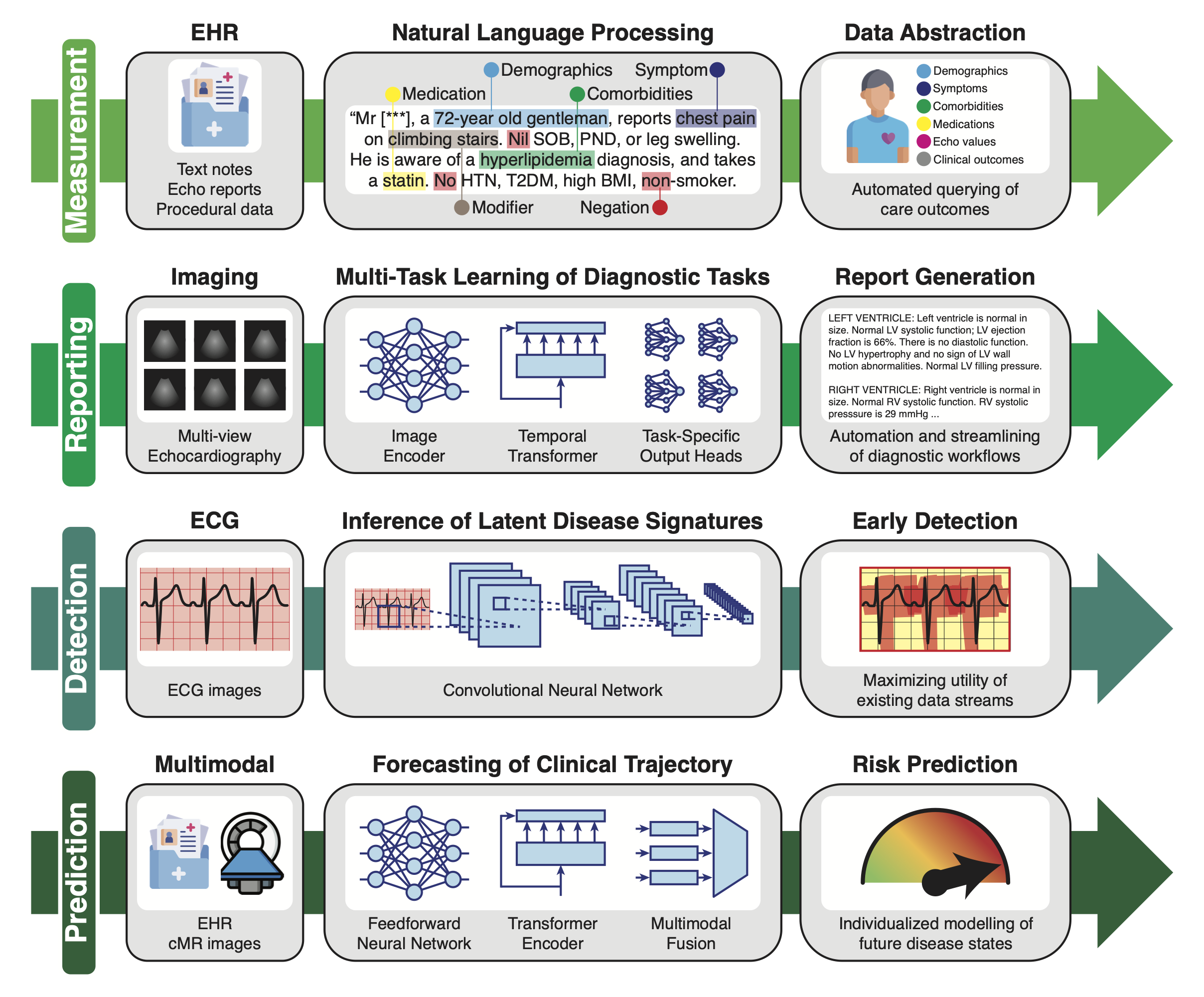
For artificial intelligence (AI) technologies to deliver on their promise in healthcare, they must translate into real-world tools that improve outcomes while ensuring care is delivered equitably (Biswas et al. JACC: Advances 2025). Aortic stenosis (AS) and heart failure with preserved ejection fraction (HFpEF) are common cardiovascular conditions that are frequently underdiagnosed, in part because key diagnostic evidence is buried in unstructured clinical narratives rather than coded fields. To address this, a series of studies developed and applied natural language processing (NLP) methods to mine echocardiography reports and clinician notes, enabling scalable identification of phenotype-positive patients and measurement of underdiagnosis across presentation, management, and outcomes. For AS, a multi-site analysis in a universal healthcare setting used text-derived phenotyping to quantify diagnostic gaps and highlight system-level targets for improvement (Biswas, Wu, et al. European Heart Journal - Digital Health 2025). For HFpEF, an NLP pipeline was developed and validated to augment structured EHR data and improve case detection at scale — supporting more representative epidemiology and creating a pathway to earlier identification and referral (Wu, Biswas, et al. European Journal of Heart Failure 2023; Brown, Biswas, et al. JACC: Advances 2024; Wu, Biswas et al. European Heart Journal - Digital Health 2025). Together, these studies demonstrate how AI can convert routinely collected clinical narratives into actionable information helping health systems pinpoint where care pathways break down, monitor performance over time, and reduce missed or delayed diagnoses.